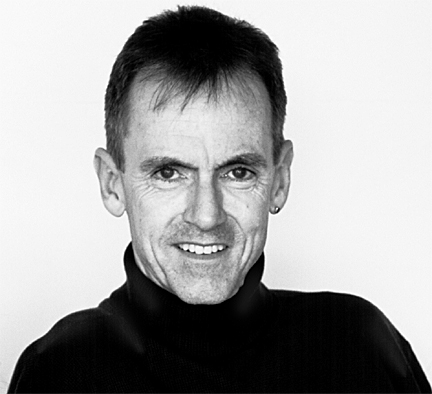
Photography found John Dunham at age 9 when he discovered a Kodak Brownie camera in a long-forgotten box and promptly burned his finger on the flash bulb. But that didn’t dissuade him. Already a keen observer of people and places, Dunham found, in the Brownie and subsequent cameras, a way to capture the essence of moments in two dimensions.
“When
I’m out of my normal environment, it’s as though I enter a heightened
state of awareness artistically,” Dunham says. “I travel light
and cheap, because that puts me more in touch with the local people and allows
me to better capture what I see.”
During
a second trip to Southeast Asia in late 2001, Dunham’s fascination with
ancient ruins—particularly the ancient, vine-covered ruins of Angkor
Wat in Cambodia— flourished. Dunham juxtaposes studies of these historic
sites with portraits of local residents, whose warmth and dignity he works
hard to encapsulate.
“The best moments to me are when I can capture the depth of someone’s emotion on film,” he says. “I try to establish a relationship with my subject, because that’s when the pictures jump out.”
Dunham began showing his work publicly in 2002, and has exhibited in numerous galleries and museums, including Stanford Art Spaces, Stanford, CA, the San Francisco and Silicon
Valley Open Studios programs; Homescapes Carmel in Carmel, California; Asia Decor in San Francisco, and the Triton Museum of Art in Santa Clara, California. His photographs also fuel the collaborative work of Transfigurist artists Dana Kawano and Remarque Loy.
The son
of two elementary school teachers, Dunham grew up in rural Connecticut and
moved in 1978 to the West Coast, where he spent 17 years in Silicon Valley’s
high-technology industry. He now makes his home in San Francisco and Hawaii.
In 1989, Dunham set out on a six-month trip around the world. His motto was, quite simply, “to go where no tourist has gone before.” He stayed true to that spirit, traveling to remote locations throughout Southeast Asia and the Middle East, often meeting people who had had no prior contact with Westerners. The experience gave the self-taught Dunham his artistic mission: to portray the untouched essence of people in their native landscapes. Since then, he has shot photographs in some 30 countries.